

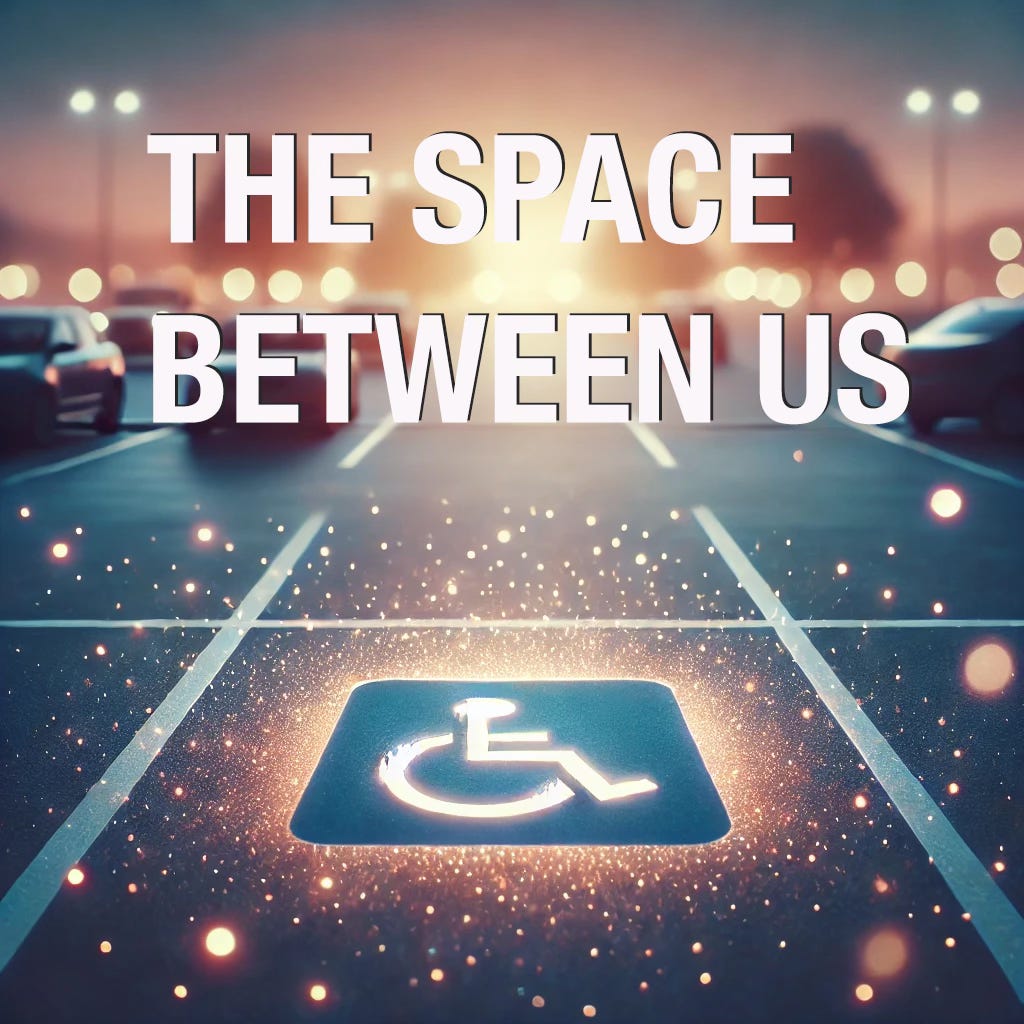
The Space Between Us

Foreword
So much of the harm we cause each other is rooted in the assumption that someone else’s needs, wants, or experiences are exactly the same as our own. Brian’s honest, vulnerable reflection on a specific experience of ableism in this essay, “The Space Between Us,” offers a call to action to reorient not only our built environment but also our cultural tendency toward oppressive assumptions that fuel ignorance and harmful ideologies.
As I watch Congress violate the rights of the country’s first trans US Congresswoman, I find myself grateful for every opportunity to question who gets to decide what another person needs and every encouragement to close the gaps in the fabric of our society that let intolerance and inequity breed. May the weight of our collective responsibility move us to use whatever influence we have to hold, especially our government leaders and systems, to ever higher standards of equity. It's not just ethical; it's a necessary element in building communities that care for our interdependent well-being.
-Katie Shaw Thompson
The Space Between Us
Brian Piñon
It has taken me over a year to write about this experience and even longer to talk about it. The memory of that day lingers with a weight I didn’t expect, making it hard to put into words. Every time I tried, the emotions would come rushing back—anger, humiliation, and something harder to name, something that made me feel small. I knew it was important to revisit this, but the act of doing so felt overwhelming. Now, it seems I can get this into words. I’m not sure why I can now. Maybe it’s the passage of time, or maybe it’s because the weight of not telling it has become harder than the revisiting it.
Let me start with a little background. In 2016, while going about my daily life, I unexpectedly lost my left leg—a stark and brutal reminder of just how fragile we all are. According to data from the US Census and the American Association of People with Disabilities, up to 70% of Americans will experience a temporary or permanent disability at some point in their lives. This means many of us may find ourselves needing accessible parking, even if only temporarily.
This is not the story of how I lost my leg. This is the story of how, last October, while having lunch at Glen Ellyn’s golf course, I received a citation for displaying the wrong handicap placard in my car. At the time, I didn’t think it would turn into one of the most humiliating experiences of my life. I had placed an expired placard out by mistake—a simple error. To resolve the issue, I brought my valid, state-issued placard to the municipality that issued the citation, thinking it would be enough to demonstrate that I qualified to park there.
It wasn’t.
What should have been a straightforward process instead became an exercise in humiliation. The official presiding over the parking hearing dismissed my explanation entirely and chose to deliver a lecture. He sternly reminded me—and the entire room—of what he called the “privileges” of being disabled. He claimed that accessible parking is not a right but something granted to people like me, provided we follow the rules exactly. “We only ask YOU to do two things,” he said. “Hang that placard up and make sure it’s up to date.”
His tone made it clear that he thought I was abusing the system. He went on to call those who make mistakes “knuckleheads,” and justified the steep fines by saying they were necessary to prevent abuse. Without any acknowledgment of my circumstances—or the fact that I had provided proof of my qualifications—he upheld the $250 fine.
I left that room feeling degraded and small. It wasn’t just the fine; it was the implication that my disability, my lived experience, wasn’t enough. It was the reminder that I am at the mercy of a system that sees my existence as a burden to be managed, not as a life worthy of dignity and respect.
The lecture about “privileges” was more than just patronizing—it was dehumanizing. When the official said, “We only ask,” what I heard was: “We, the able-bodied, demand that you, the disabled, constantly prove your worthiness.” And it’s not just me. This is the reality for many people with disabilities who depend on accessible parking.
Fines for parking violations are meant to prevent abuse, but that’s not what happened here. I didn’t park somewhere I wasn’t supposed to. I didn’t take a spot I wasn’t qualified to use. I made a documentation error, but I was treated like an abuser, a fraud. The steep fine didn’t teach me a lesson about following rules—it taught me that using accessible parking comes with risk.
It’s a risk I now carry every time I park. What if I forget to hang my placard again? What if someone questions whether I “look disabled enough?” What if the next time, it’s not just a fine, but harassment?
The anxiety this incident caused was overwhelming. For months, I dreaded using accessible parking. I had anxiety attacks every time I pulled into a designated spot, worrying that I’d made another mistake or that someone would confront me. This fear isn’t unique to me. Many people with disabilities live with the same worry—that we will be judged, harassed, or penalized for simply existing in public spaces.
This is especially true for those of us with limb loss or other less visible disabilities. When I transition from wearing shorts to long pants in colder months, I know I don’t “look” disabled to some people. I’ve already experienced harassment for parking in accessible spots, and I know I’m not alone in this. For many of us, these fears are constant companions.
Accessible parking isn’t a privilege—it’s a necessity. I really need it to live my life. I only have so many steps in a day before I need to give my prosthetic a rest. The system exists to help people like me navigate a world that isn’t designed for us. But when mistakes like mine are treated as abuses, the system fails its most vulnerable users.
Here’s what needs to change:
Reform Fines: People who can prove they qualify for accessible parking shouldn’t be penalized for documentation errors, or forgetting to hang their placard. There should be a clear distinction between abuse and honest mistakes.
Improve Administrative Processes: Acquiring handicap plates or placards shouldn’t involve convoluted procedures that deter people from seeking permanent solutions. Modernize the process to make it accessible and efficient.
Empathy in Enforcement: Officials need training to approach these situations with understanding. Disabled people shouldn’t leave hearings feeling humiliated or degraded.
As much as the anger and humiliation of that day have stayed with me, it’s the regret that feels heaviest. I regret not speaking up at the moment—not just for myself, but for anyone else in that room who might have been there for the same reason. I regret not challenging the official. I regret letting his words linger unchallenged, knowing they might have reinforced the shame or silence of others like me.
In that moment, I felt like I had let myself down. I’m not one to let things like this go unchallenged. I’m known for saying quiet things out loud. But I was so caught off guard. I couldn’t pull it together. I had let my story go unheard, and in doing so, I had let others down, too. So I write this now to say what I couldn’t say then: Accessible parking is not a privilege. It’s a necessity. And the system designed to provide it must do better—not just for me, but for everyone it’s meant to support.
Join us by the fire: Share your thoughts.
Being caught off guard, hands over a lot of information to be processed. Sometimes it never gets processed.
Your experience left me throttled with emotions regarding the way you were treated and how others were held hostage to witness the official’s abuse.
Yes, the process in this technical world needs to be easier. I think “What toxic existence is this official experiencing to be so cruel?” There is no need for this. When proper documentation is obtained then that should be known electronically without a ticket being issued.
I am so glad you were able to find your words to process the information from that haunting day. You have been heard. I hear you.